Octopus Work

The studio has been loud lately, not in sound, but in pull.

I’m working across multiple series at once, moving from one piece to another, then back again. Rope on one table. Foraged material drying in the corner. A vessel half-bound. A line of thought that won’t sit still. It feels a little ADHD in the studio, attention splitting, doubling back, chasing sparks before they cool.

It’s a gift and a curse.

Focus, for me, doesn’t look like a straight line. It looks like orbit. One piece unlocks another. Finishing something doesn’t close it, it opens a door. I’ll tie off one work and immediately see where it wants to go next. So I follow it, even if it means holding five things at once.

Right now, I’m in that stretch, finishing, resolving, pushing pieces to their edge while new ideas keep interrupting. I don’t fight it. I work like an octopus, reaching, holding, testing, building across everything all at once.

All of it is moving toward my solo show at Cane Roots Gallery in Christiansted, opening later this year. The work is rooted here, in St. Croix. New rhythms. New materials. New material histories. What the land offers. What the sea leaves behind. What the island reveals over time.

There are not enough hours in the day to bring every idea into the light. I’ve had to accept that. Some things will wait. Some will evolve. Some will never be made and that’s part of the practice too.

But what is here, what is becoming, is enough.

Each piece carries the imprint of this moment of working in motion, of holding many threads, of trusting that even in the scatter, there is a pattern forming.

I just have to keep my hands in it.
The Work Beneath the Work

There is a kind of work that happens before the work.

It doesn’t photograph well.
It doesn’t post.
It doesn’t announce itself as progress.

It looks like walking.
Reading.
Sitting with something that hasn’t found its form yet.

It looks like silence.

I’ve learned not to rush that space anymore.
The in-between is not empty.
It’s where things are rearranging—quietly, stubbornly, beneath the surface.

For a long time, I thought sustaining a creative life meant producing constantly.
Keeping pace.
Keeping up.

But that’s not what holds.

What holds is the ability to return.
To come back to the work without ceremony.
Without perfection.
Without waiting to feel ready.

To return when it’s unclear.
When it’s slow.
When it feels like nothing is happening.

Because something is always happening.

These days, I ask myself simpler questions:
What is my practice asking of me right now?
What is the smallest way I can show up today?

And I listen.

Making room has become part of the work.
Not a pause from it,
but the place where it begins.

Between Shore and Source

In this world,
we move as pilgrims,
marked by water,
walking the thin edge
between dust and forever.

The waters recognize us,
ancient, patient,
older than our names.
We are drawn, like the moon,
toward what first gave us breath.

When the waves rise,
they do not threaten.
They beckon.
a remembering,
a call we’ve heard before.

Here, surrender is not loss.
It is released.
A yielding that leads
not to vanishing,
but to return.

Currents carry us
back toward mercy,
back toward the place
where beginnings still wait.

As rivers loosen their grip
and open into the sea,
so we learn to let go
of what weighs the soul.

In the depths,
there is no striving.
Only rest.

And in the quiet heart of the waters,
we are gathered,
held,
and made whole.

a poem by Theda Sandiford

Making Space for the Work That Matters

I used to believe productivity and my creativity were at war with each other, that structure belonged to the corporate world, and creativity lived everywhere else. But the more I lean into my studio practice, the clearer it becomes: productivity isn’t the opposite of creativity; it’s what protects it.

Stepping back from a 9–5 has given me the room to see this truth more clearly.
Yes, I’m still juggling corporate consulting commitments, but I do that work with intention, so I can pour more energy into my art, build out Sky Garden Residency programming, and finally apply to artist residencies I simply didn’t have time for before.

What I’m learning is that structure creates possibility.

A calendar, a to-do list, a weekly rhythm…
These aren’t constraints, they’re scaffolding.
They hold space for experimentation, ritual, rest, and the slow research my work needs.

This season is about making room:
room to weave and wander,
room to say yes to opportunities that nourish me,
room to deepen community and make the kind of art that takes time.

If productivity gives me that room, I’ll embrace it, gratefully.

Textiles as Testimony: Creative Activism, Memory and Making

My work lives at the intersection of creative activism and care. It is rooted in a belief that art can be a tool for social justice, one that invites people to touch, to gather, to remember, and to reckon. Through interactive installations and public-facing projects, I explore decolonization not as an abstract theory, but as a lived, material practice. I work through tactility, storytelling, and memory mining, allowing the body, hands, hair, fiber, soil, sand to hold knowledge that words alone cannot.

Recycling and repurposing are central to my practice. Nearly everything I use has already lived a life: clothing worn by friends and family, discarded marine debris, overlooked materials deemed broken or expendable. These materials are transformed into rope, vessels, and sculptural forms that merge the personal with the collective. In this process, I engage in shadow work, addressing what has been marginalized, silenced, or rendered invisible by colonial systems. Natural hairstyles like braids and locs, long questioned in white spaces for their “respectability” or professionalism, become both material and metaphor, sites of resistance, pride, and embodied history.

My work is also deeply eco-social. It exists at the intersection of gardening and art, land and labor, place and belonging. Whether through placemaking, public engagement, or community-centered rituals, I am interested in how we tend to what we inherit, culturally, environmentally, and spiritually. Like a garden, this work requires attention, patience, and care. It asks what can be composted, what can be repaired,

The Ritual of Cleaning

Every Friday, I clean my studio.
It is not a chore, it is a ritual, a meditation that drives my practice forward. As I put things away, I am not just tidying; I am revisiting. Each clear plastic bin is a library of experiences, a living archive of histories waiting to be rediscovered, retold, and remixed.

Sometimes, a material I had tucked aside calls out insistently, use me now. Other times, I stumble upon a project I had abandoned in frustration, only to find that the solution has quietly revealed itself with time. What was once stuck begins to flow again.

The act of cycling through materials becomes a dialogue. Textures whisper stories, colors tug at memories, and forgotten scraps offer new directions. In these moments, the materiality of my practice shows itself as storytelling, guiding my hands and spirit.

Cleaning becomes organizing my ideas, making space for clarity. It often spills into journaling, as I empty out mental lists and thoughts into my sketchbook, making room for new ones to arrive. Because I am always working on multiple projects at once, this weekly ritual is an editing process, helping me to focus, reset, and refine.

And when the work is done, when every bin is re-stacked and every surface clear, my studio stands ready, an open field for the next round of experiments. Friday cleaning is both an ending and a beginning, a pause that breathes new life into my practice.

Between Rain and Ripening

While life Stateside begins to slow for winter, here in St. Croix the pace is quickening. Fall and winter are our busy months, visitors arriving, holiday parties unfolding, fruits ripening faster than I can harvest them. The rainy season is in full swing; the orchids are blooming, and both the Java Plum and Coco Plum trees are heavy with fruit. Some of the mango trees, stubborn and generous, are still producing too.

I’ve started gathering mahogany seed pods for future art projects, each one a small promise of what’s to come. The seasonal residents will soon be back, which means restaurant reservations will become competitive sport. And yet, all I want to do is nest in the studio. I have nine works in progress waiting for my hands, plus a handful of new ideas elbowing their way to the front of the line.

I had hoped to spend this season reflecting on growth and gratitude, but truthfully, I’m feeling overwhelmed. There’s a certain kind of fullness that comes with this time of year, a lushness that’s both beautiful and demanding. The rain feeds everything at once: the fruit, the flowers, the ideas, the obligations.

Maybe that’s its own kind of gratitude, to be overflowing with possibilities, even when there aren’t enough hours in the day.

I Make Meaning

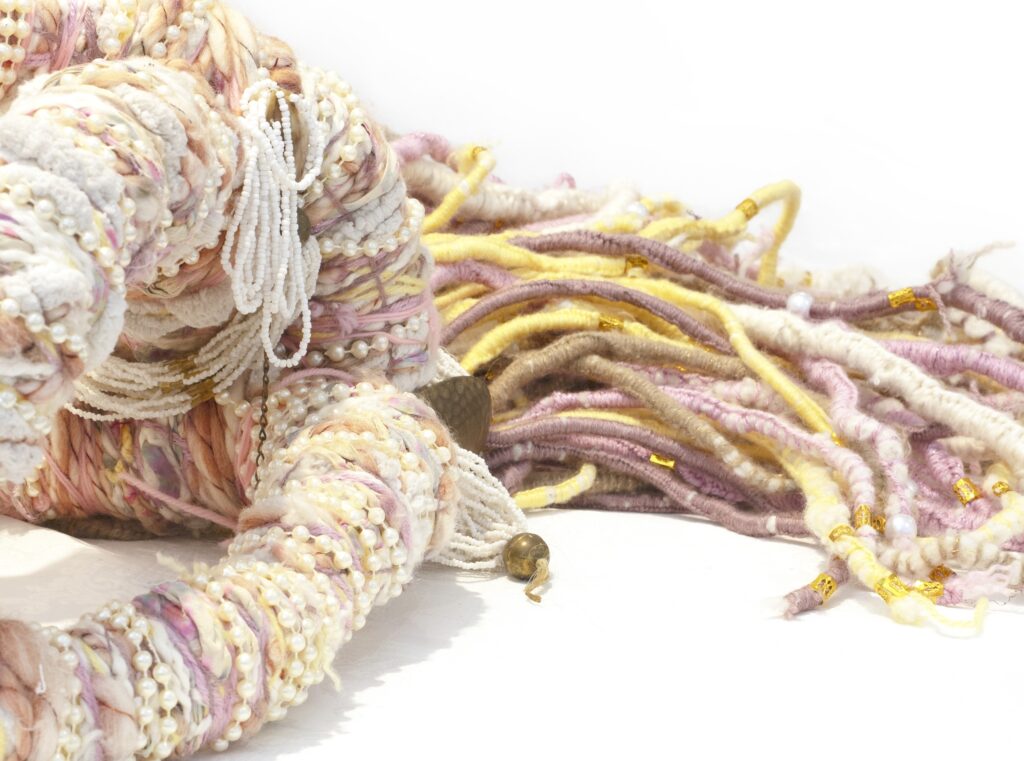
I’ve come to understand that my work isn’t just about creating objects. It’s about memory, materiality, and spirit. Everything I make; wrapped, woven, knotted, scavenged, stitched, or adorned, is a form of testimony, offering, and witnessing. I don’t work in isolation. I work in collaboration with community, ancestors, with land and water, with discarded things, with stories people have tried to bury.

My relationship with spirit has never followed a straight line. I was raised Unitarian and only recently learned that my father served as a Deacon in the Episcopal Church. That discovery reframed things I didn’t know I was carrying. And earlier this year, when I traveled to Rome on pilgrimage with McCarty, I received a series of quiet but undeniable signs pulling me toward a deeper, more embodied practice of faith. Not about labels, but about ritual, remembrance, and devotion.

I don’t separate that calling from my art. My materials, marine debris, fibers, beads, plastics, hair, ephemera are more than tools. They are archives. They hold grief, joy, migration, violence, survival, and protection. The transformation isn’t about erasing what was, it’s about uncovering it and letting it speak in a new form.

My practice is also a form of resistance. I confront microaggressions and the everyday cuts of bias through the act of making. Knotting is meditation. Weaving is reclamation. Wrapping is healing. Vessel building is ancestral technology. What some see as trash, I treat as evidence and essence, of impact, erasure, resilience, and spirit.

I am a community builder as much as I am an artist. I don’t create in isolation, I create in relation. Through workshops, mentorship, storytelling, and gathering, I make space for others to root into their own narratives. My studio residency, Sky Garden STX isn’t just a place, it’s a sanctuary in motion, a land-based altar, a future site for remembrance and making.

In the studio, intuition and ritual live side by side. A shell can hold memory. A piece of rope can hold history. A found object can become a portal. I don’t see my evolving faith as a departure from anything I’ve been, only as another thread in the braid, intertwined with ancestral memory, folk wisdom, and the quiet instructions of the materials themselves.

If there’s a throughline in everything I do, it is this:

I remember forward.
I work with what others overlook.
I build from what has been broken.
I create portals where stories can live again.

I don’t just make work.
I make meaning.
And I make room, for what has been, what is becoming, and what is calling me next.

Nesting Into Inspiration

This month has been a season of settling in, creating, and reconnecting with my practice. I’ve been nesting in my studio, opening long-forgotten boxes, sorting materials, and rediscovering treasures that feel like gifts waiting to be transformed. There’s something grounding about this process of organizing and making space; each thread, each object, reminds me of where I’ve been and what’s possible.

Hurricane season has brought its own rhythm. The rains return, streams carve their paths through the property, uncovering shards of pottery and even revealing waterfalls. We’ve been clearing walking paths to open up the waterfall that flows between our home and the residency property, a reminder of how nature constantly reshapes and uncovers what is hidden.

I’ve been cutting back invasive vines, and soon their fibers will find their way into my work. I’ve also been upcycling rope, fabric, and leftover yarn into the beginnings of new projects that are slowly, patiently coming together. When the power goes out and I’m forced to shelter in place, I take it as an invitation to slow down, to listen, and to let the work unfold at its own pace.

In this season, I’m learning again that inspiration isn’t something to chase. It emerges naturally, like streams after the rain, if I make space, clear the path, and let it flow.