Threads of Devotion: The Book of Kells

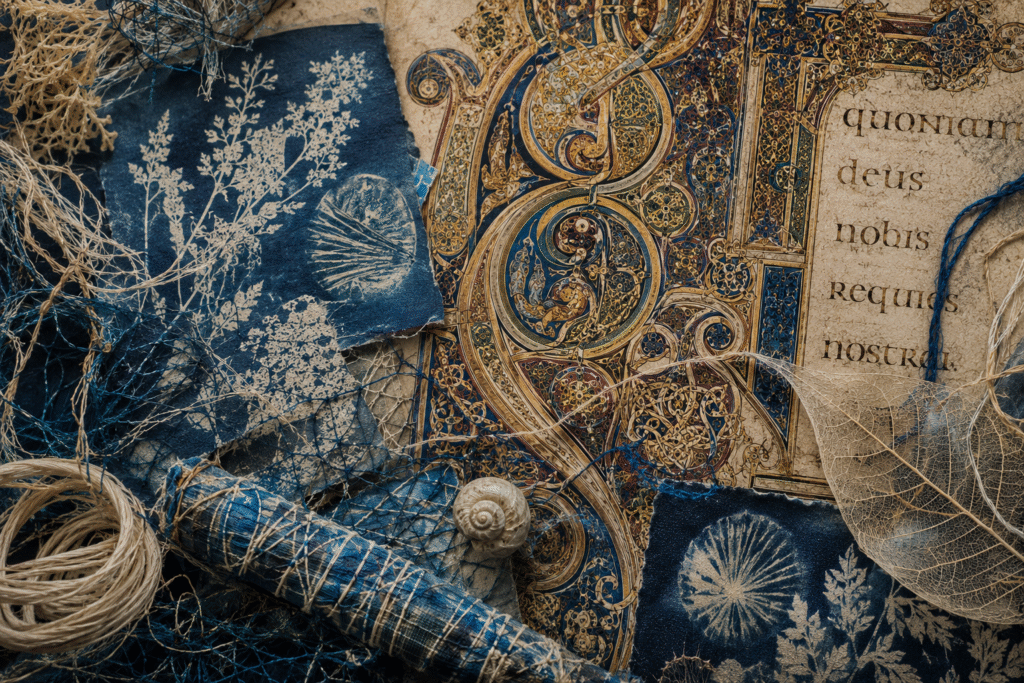
Reading about the new research surrounding the origins of the Book of Kells brought me back to the time I spent studying its pages last summer. Scholars are now reconsidering whether the manuscript may have originated in the Pictish monastery of Portmahomack in Scotland rather than solely within the Irish tradition it has long been associated with. What stayed with me most was the discussion around material process, vellum making, pigments, carving, ornament, and the close relationship between labor, devotion, and land.

While reading, I found myself thinking about how the Book of Kells moves beyond manuscript tradition and becomes something deeply tied to material knowledge and human touch. The layering of spirals, botanical forms, animals, symbols, and ornament carries a sense of accumulated care and attention over time. It also made me reflect on my own interest in wrapping, knotting, cyanotype, marine debris, and plant knowledge as ways materials can hold memory.

The manuscript is a reminder that making has long been connected to preservation, ritual, and the passing of knowledge across generations. Even centuries later, these works continue to speak through their materials as much as through their imagery.
Rediscovering Sari Dienes — Gratitude for My YouTube MFA

I am having one of those bittersweet, full-circle moments, the kind where disappointment and delight show up holding hands.

While going deep down the rabbit hole researching altered tins and assemblage artists, I landed on not one, but two videos about Sari Dienes. And suddenly I was hit with a realization:

How did I forget her?

I know I’ve seen Sari’s work before, likely in some New York museum or gallery when I was a teenager roaming the city hungry for art, I didn’t yet have language for. I remember being struck by her permission to use anything, flattened tin cans, driftwood, street rubbings, debris, as treasured material. Her rhythm felt familiar. Like a cousin I didn’t know I had.

And yet… I never truly clocked her. She was buried somewhere in the unlabeled vault of “things I’ve seen that shaped me before I knew they had.”

So yes, I am disappointed in myself for not being conscious of that connection earlier. For not honoring an influence sooner. For all the times I’ve spoken about assemblage without saying her name.

But oh, how grateful I am to meet her again now, not as a teenager looking up at art, but as an artist looking sideways across time, recognizing a fellow traveler.

This is why I thankful to the University of YouTube. My YouTube MFA studies are ongoing and fully immersive. Tuition is free but the tuition cost is humility, the willingness to admit that everything I think I know must be periodically burned down to make room for what I do not yet know.

I am learning to surrender certainty. To let curiosity guide me instead of credentials.

So here I am, deep in the tin shrine, reliquary, assemblage wormhole, and Sari Dienes has entered the chat like a long-lost friend tapping me on the shoulder saying:

“I’ve been waiting for you to notice.”

And now that I have, I’m listening.

Lenore Tawney: A Glimpse into Her Studio

Lenore Tawney redefined how we see textiles, lifting them beyond craft into the realm of fine art. Watching archival footage of her in her Coenties Slip studio in New York City, circa 1960, long before I was born, feels like being granted a window into history.

Technology allows me to sit here decades later and witness her world: the light streaming in by her favorite chair, a feisty cat chasing stray strings, drawers of yarn meticulously sorted by color. These small, intimate details make my heart sing.

The clip also stirs memories of my own time in Jersey City, working in my 150 Bay Street studio overlooking the Hudson River. Like Tawney, I found inspiration in both the view and the rhythm of everyday studio life. Her practice reminds me how the simplest gestures, thread, light, and place, can transform into something transcendent.

St. Hildegard of Bingen: Mystic, Maker, Medicine Woman

St. Hildegard of Bingen (1098–1179) was a German mystic, composer, writer, healer, and abbess, one of the most remarkable women of the Middle Ages. A visionary and Doctor of the Church, she integrated spiritual insight with music, natural medicine, and ecological wisdom.

She authored major theological works based on her visions, composed over 70 original chants (writing both music and lyrics), and produced texts on healing, botany, and natural history. Hildegard’s holistic approach saw the body, mind, and spirit as deeply interconnected, and her remedies drew from plants, food, and elements of nature.

Lately, I’ve been immersing myself in her world listening to her celestial chants, reading her herbal remedies, testing her recipes, and studying her illuminations. Her work is more than historical, it feels like a living lineage, a call to remember the sacred intelligence of the body, the earth and spirit.

A fierce intellect and spiritual force, Hildegard spoke truth to power and left behind a body of work that still inspires mystics, artists, and healers like me today.

Salting Grief and Grace

In both Japanese funerary rites and Afro-Caribbean spiritual practices, salt is a sacred purifier, used to ward off evil spirits and cleanse the lingering energy of death. Whether sprinkled outside the home after a funeral or offered at an ancestral altar, salt marks the boundary between the living and the dead. I grew up throwing salt over my shoulder, into fire, or into moving water, a ritual of release and banishment, echoing traditions that span oceans and generations.

Listening Like a Plant in St. Croix

Michael Pollan’s The Botany of Desire: A Plant’s-Eye View of the World reframes how we see the green world around us—not as passive, cultivated objects, but as active participants in shaping our desires. It’s a perspective that lingers long after the last page, especially here in St. Croix, where the land hums with quiet intelligence.

Pollan’s invitation to view plants as co-creators made me reconsider the medicinal herbs growing wild across my property. Guinea hen weed curling through the underbrush. Lemongrass swaying in the trade winds. Turmeric pushing up in my raised planters. These plants aren’t just there. They arrive, they signal, they speak—if we’re willing to listen.

What if these plants are already in conversation with us, guiding us to notice where balance is needed, where healing is overdue?

Since reading the book, I’ve begun to move more slowly through the land, letting my hands hover before touching, asking inwardly before harvesting. I’m starting to feel that these plants are not just medicine for the body, but memory-keepers, storytellers, and perhaps, old friends with lessons still unfolding.

In St. Croix, where ecological wisdom is hiding in plain sight, The Botany of Desire offers a gentle challenge: to listen more deeply, to be in relationship, not just use.

What might change if we all listened like the plants do—rooted, attentive, and open to what the land is trying to say?