I’m honored to share that my work will be included in FIBER 2026 at AlterWork Studios in Long Island City.
This exhibition gathers artists rooted in traditional fiber practices alongside those pushing the edges of contemporary textile work. It feels like home, structure and experimentation in the same room.
March 7–28, 2026 Opening Reception: Saturday, March 7 | 6–9PM AlterWork Studios 40-20 22nd Street, Long Island City, NY
I’ll be showing:
Power Puff, Black Racing Stripe Emotional Baggage Cart
Power Puff with Black Racing Stripe Emotional Baggage Cart
Theda Sandiford
Bike reflectors and bell, paracord, Fresh Direct bag yarn, doggie poop bags, plastic newspaper bags and plastic grocery bags woven on gold spray painted recovered shopping cart.
36 x 40 x 24 in
2021
We all carry emotional baggage. Some of us push carts. Some carry backpacks.
I carry a lifetime of racial trauma.
This piece transforms BAD NEWS into something radiant. Plastic New York Post sleeves become structure. Gold becomes insistence. The black racing stripe becomes momentum.
I choose joyful resistance.
Not denial. Alchemy.
If you’re in New York, come stand beside the cart. Listen for the bell.
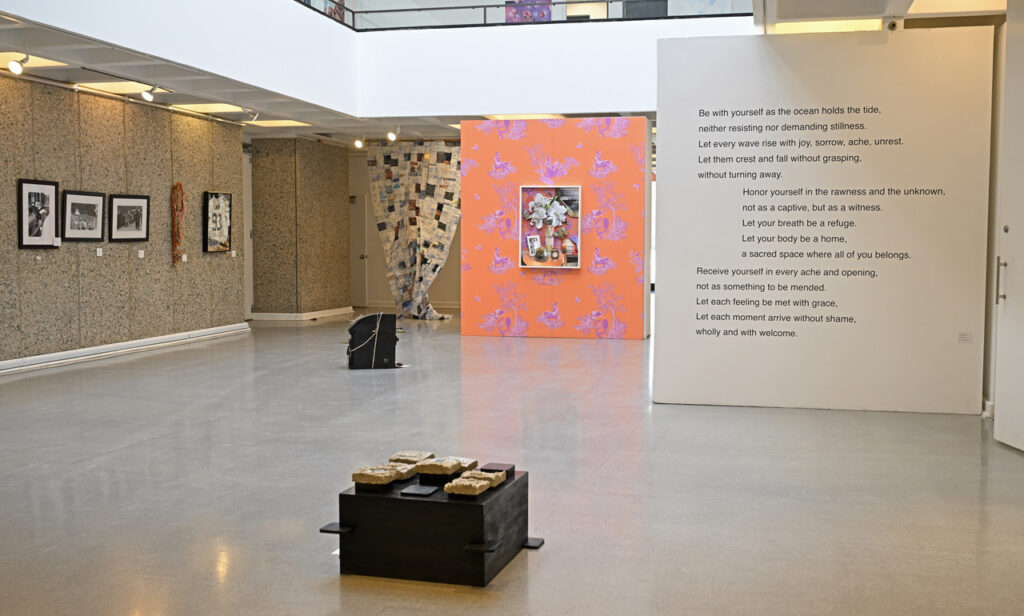
As Borderlands: Soft Margins, Hard Truths closes at Cummings Art Galleries, I keep thinking about thresholds.
Curated by nico w. okoro, the exhibition asked us to look closely at race, space, and place and to imagine something freer than the histories that shaped them. The work was soft in material, but steady in truth.
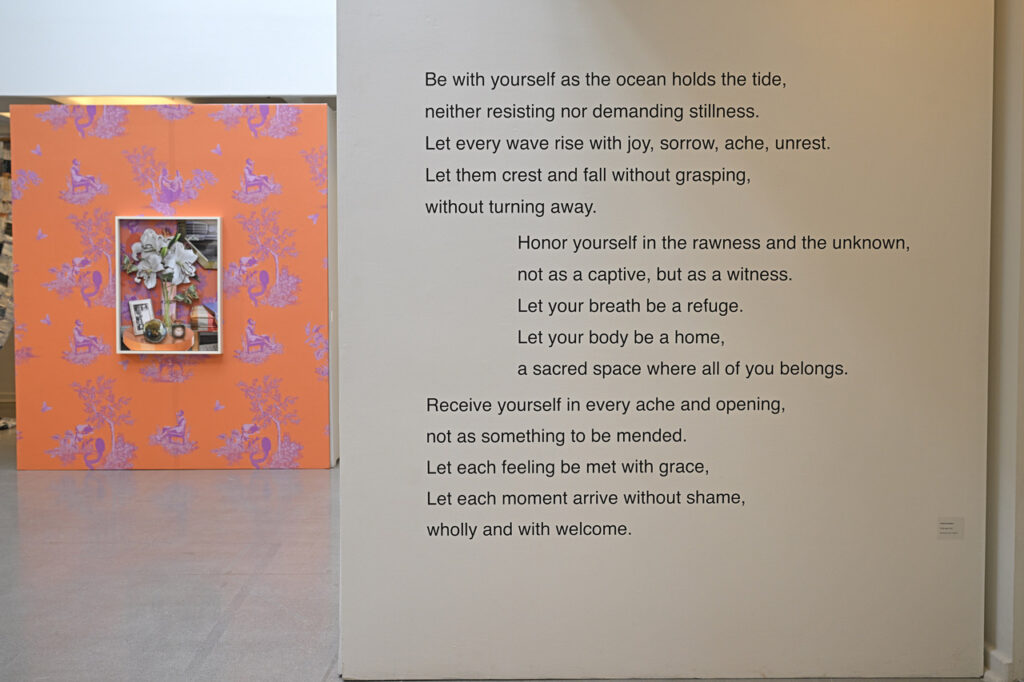
This show also held a first for me. It was the first time my poetry was shared publicly in a gallery. Seeing my words on the wall felt makes me feel exposed. And somehow exactly right. Another layer of my practice stepping into the light.
Borderlands aren’t theoretical for me. They live in the body. In identity. In the small adjustments we make to move through rooms not built with us in mind.
March holds my work in two different spaces, each asking urgent questions about race, place, memory, and power.
Borderlands: Soft Margins, Hard Truths
January 20 – March 6, 2026 Closing: March 6 Cummings Art Galleries Connecticut College, New London, CT
Borderlands dismantles the social constructs of race, space, and place, imagining an end to the colonial legacies that bind them.
The idea of borderlands feels deeply embodied in my practice, the Atlantic as archive, mixed race identity, code-switching as survival, material memory woven from what remains. Borders are not only geographic. They live in systems, in land, in the body.
This exhibition closes March 6.
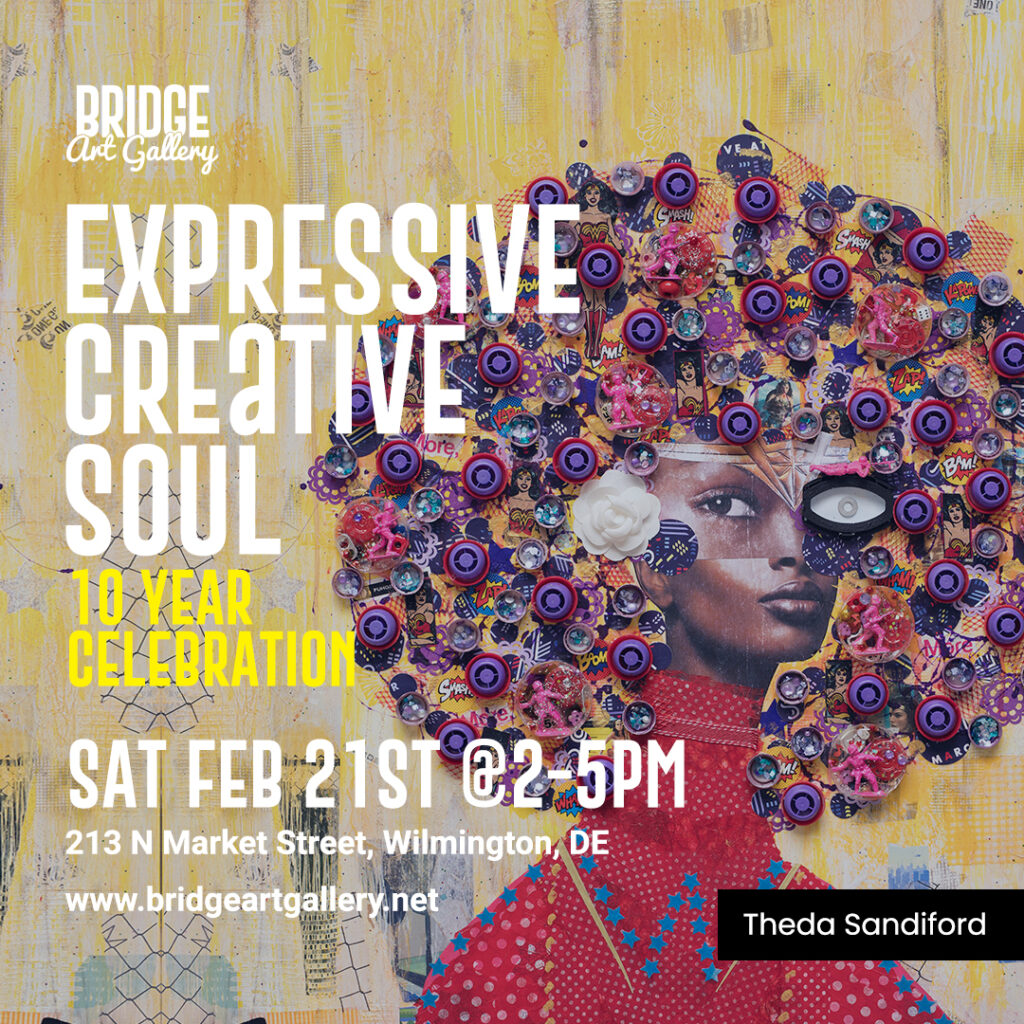
Expressive Creative Soul 2026
February 21 – March 21, 2026 Bridge Art Gallery Wilmington, DE
Celebrating ten years of bold creative voices, this exhibition includes my works Wonder Women Tapestry and Wonder Woman Selfie posters, centering Black womanhood as strength, complexity, and sovereignty.
Bridge Art Gallery has supported my journey for years, and I’m honored to be part of this milestone. Though I won’t attend in person, I’m there in spirit.
Two exhibitions. Different geographies. One thread, truth, resilience, and the power of holding space.
During my CritLab fellowship, artist and curator Patricia Miranda offered a reframe that shifted me:
Celebrate the rejection.
Because rejection means you participated. It means you answered the call. It means you allowed yourself to be seen.
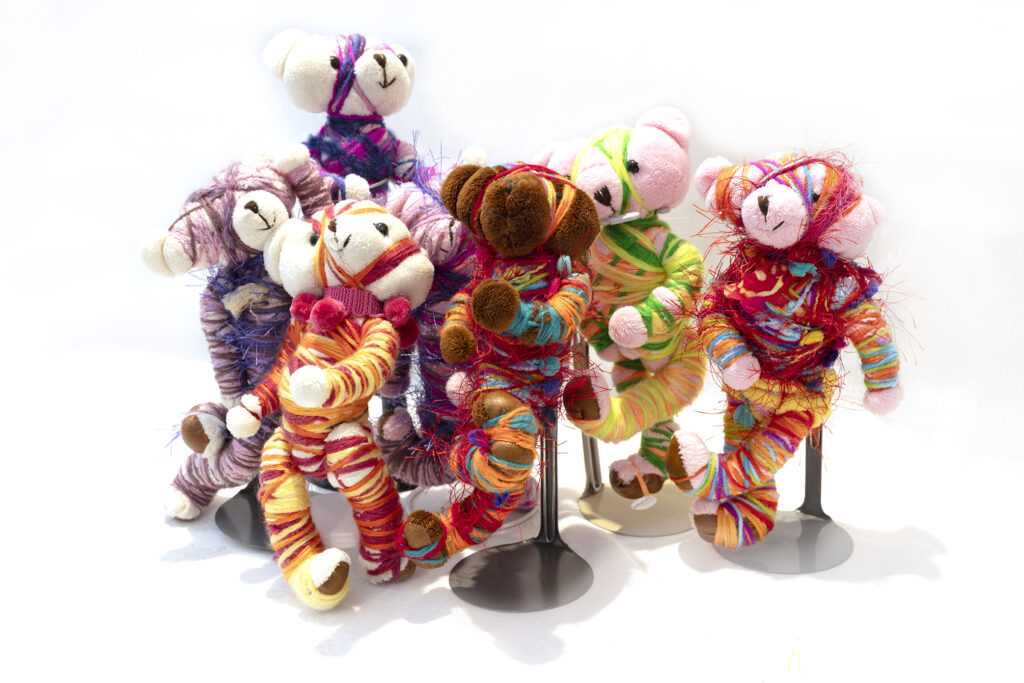
I recently submitted my Mummy Bears to a call centered on grief. That submission, not the outcome, was the milestone.
The Mummy Bears are for me and my dad. Every year on my birthday, March 11, he gave me a teddy bear and called me Bear. After dementia took his memory and he passed at Thanksgiving 2024, I began wrapping the bears. Preserving what I could.
Submitting that work was the next step in processing my grief.
The no does not change the ritual. It does not change the love.
It simply confirms that I am participating.
As my birthday approaches, the day I feel his absence most, I am proud that I pressed submit. That I let my grief breathe outside the studio.
Rejection is not failure.
It is proof that I am still making. Still risking tenderness. Still moving forward.
I used to believe productivity and my creativity were at war with each other, that structure belonged to the corporate world, and creativity lived everywhere else. But the more I lean into my studio practice, the clearer it becomes: productivity isn’t the opposite of creativity; it’s what protects it.
Stepping back from a 9–5 has given me the room to see this truth more clearly. Yes, I’m still juggling corporate consulting commitments, but I do that work with intention, so I can pour more energy into my art, build out Sky Garden Residency programming, and finally apply to artist residencies I simply didn’t have time for before.
What I’m learning is that structure creates possibility.
A calendar, a to-do list, a weekly rhythm… These aren’t constraints, they’re scaffolding. They hold space for experimentation, ritual, rest, and the slow research my work needs.
This season is about making room: room to weave and wander, room to say yes to opportunities that nourish me, room to deepen community and make the kind of art that takes time.
If productivity gives me that room, I’ll embrace it, gratefully.
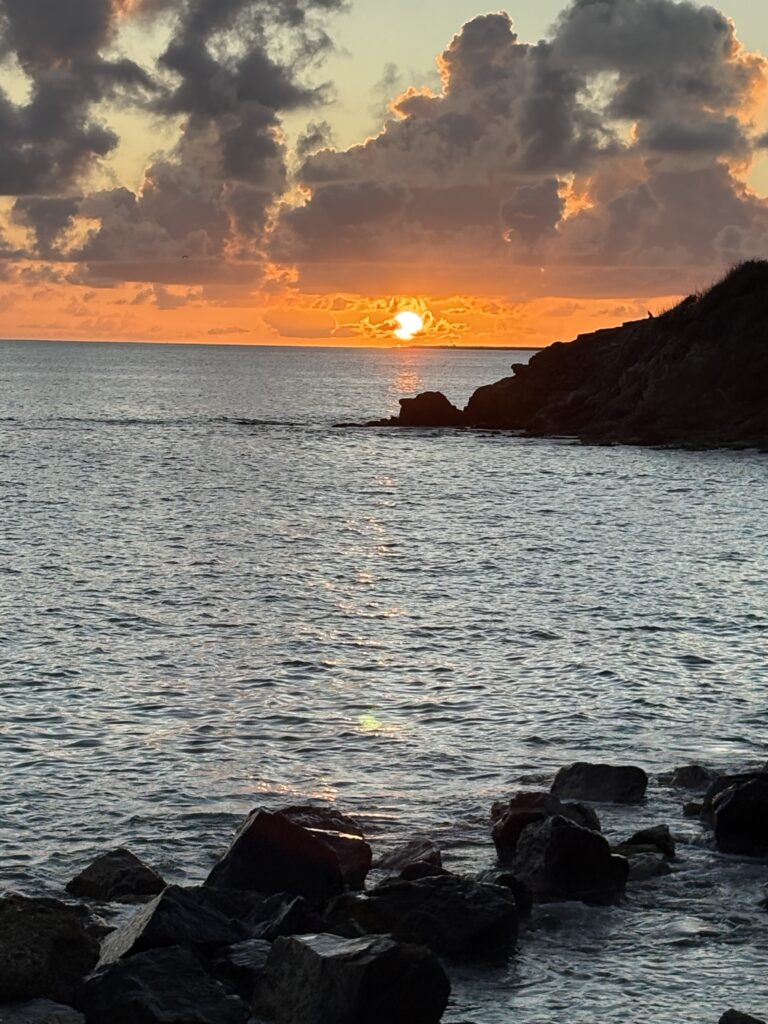
I’m excited to be participating in this year’s Great Mangrove Cleanup at Altona Lagoon, a day of caring for coastal ecosystems while removing marine debris from the mangroves.
Hosted by the University of the Virgin Islands and the Department of Planning and Natural Resources, these cleanups have removed over 26 tons of debris from mangrove forests across the territory since 2018. I love that this work supports the environment and creates space for thoughtful reuse of ocean-recovered materials in my art practice.
Saturday, February 21, 2026 9:00 AM – 12:00 PM Altona Lagoon, St. Croix
If you’d like to join me, whether to give back, or simply spend time caring for the land and water, I’d love to see you.
This evolving sculptural work emerges from recovered marine line, sea-tumbled and woven with my Aunt Terry’s yellow baby yarn, entangling care, loss, and inheritance. Rooted in the Atlantic as a water grave, it imagines what might form if those taken by the ocean did not vanish, but transformed, absorbed into marine systems, reshaped by pressure, time, and survival.
Built from hurricane-recovered debris, hair, shells, and industrial fragments, the work treats mutation as a strategy rather than a wound. It is not a fixed memorial, but a living anatomy in progress, an offering that shifts as memory settles, asking the ocean to be read not only as a site of rupture, but as an active, generative archive.
Bridge Art Gallery – Anniversary Opening, February 21
On February 21, Expressive Creative Soul celebrates its 10-Year Anniversary at Bridge Art Gallery, a milestone that means so much to me.
Although I won’t be able to attend in person, I will absolutely be there in spirit.
Bridge Art Gallery has been a meaningful supporter along my artistic journey. They have made space for work that is layered, socially engaged, and rooted in lived experience. They have believed in my voice and in the stories embedded in my materials. That kind of sustained support is not small, it is formative.
To be included in this anniversary exhibition feels like standing inside a shared history of courage and creative commitment.
I am honored that Wonder Women Tapestry and Wonder Woman Selfie will be featured as part of this celebration.
Wonder Women Tapestry
Created in 2018 through a series of sewing circles, Wonder Women Tapestry is a 120” x 96” collective offering. Friends, friends of friends, and even strangers off the street gathered to stitch beads, bottle caps, mirrors, and embroidered details into its surface.
The tapestry carries the energy of many hands. It honors Black womanhood not as fantasy, but as lived heroism—resilient, radiant, and communal.
Wonder Woman Selfie
Wonder Woman Selfie turns the lens inward. It is about self-representation and the power of claiming our own iconography. It asks what it means for a Black woman to frame herself as powerful—to define the narrative rather than inherit it.
Together, these works speak to community and self-definition, to gathering and to claiming space.
A Decade of Impact
For ten years, Expressive Creative Soul has uplifted artists who lead with story, culture, and truth. That consistency matters. That commitment shapes careers.
I am deeply grateful to Christopher and Cheryl Mack for their vision and for walking alongside artists with integrity and heart.
While I may not be physically present on February 21, know that my gratitude, my spirit, and my celebration are fully there.
Congratulations to Bridge Art Gallery on 10 powerful years. May the next decade be even bolder.
My work lives at the intersection of creative activism and care. It is rooted in a belief that art can be a tool for social justice, one that invites people to touch, to gather, to remember, and to reckon. Through interactive installations and public-facing projects, I explore decolonization not as an abstract theory, but as a lived, material practice. I work through tactility, storytelling, and memory mining, allowing the body, hands, hair, fiber, soil, sand to hold knowledge that words alone cannot.
Recycling and repurposing are central to my practice. Nearly everything I use has already lived a life: clothing worn by friends and family, discarded marine debris, overlooked materials deemed broken or expendable. These materials are transformed into rope, vessels, and sculptural forms that merge the personal with the collective. In this process, I engage in shadow work, addressing what has been marginalized, silenced, or rendered invisible by colonial systems. Natural hairstyles like braids and locs, long questioned in white spaces for their “respectability” or professionalism, become both material and metaphor, sites of resistance, pride, and embodied history.
My work is also deeply eco-social. It exists at the intersection of gardening and art, land and labor, place and belonging. Whether through placemaking, public engagement, or community-centered rituals, I am interested in how we tend to what we inherit, culturally, environmentally, and spiritually. Like a garden, this work requires attention, patience, and care. It asks what can be composted, what can be repaired,