


There is something slightly ironic about creating an artwork for America250 while living in a United States territory where many residents cannot vote for the president determining so much of our daily reality.
That tension sits quietly inside Polyurethane Paradise: Rainforest Rhapsody.
The work is included in Weathered Structures, part of the Miami Fiber Triennial 2026, a program connected to Threading the City: America250. While the broader celebration reflects on 250 years of America, I find myself considering what “America” means from the vantage point of St. Croix, US Virgin Islands, a place shaped by colonialism, tourism, environmental vulnerability, migration, and complicated citizenship.
From the outside, the Caribbean is often imagined as paradise.
And it is beautiful.
But paradise also arrives wrapped in plastic.
The work draws inspiration from the dense rainforest vegetation surrounding my home and studio in St. Croix. I wove together discarded single-use bottle caps into tangled vines, looping growths, and synthetic blooms inspired by heliconias, orchids, and Birds of Paradise. What first appears lush and celebratory slowly reveals itself as petroleum-based excess masquerading as tropical abundance.
Plastic has become one of the most persistent materials shaping island life. It washes ashore after storms, lodges itself into mangroves, drifts through guts and gutters, and survives longer than many of the systems meant to manage it. In island environments, consumption and disposal become impossible to separate from ecology.
The title Polyurethane Paradise intentionally leans into contradiction.
The work asks: What does paradise look like when filtered through tourism, waste, climate instability, and colonial economics? What does environmental celebration mean when the very materials used to sustain convenience are choking the landscapes they imitate?
As a place-based artist, I often forage shoreline debris, marine waste, seed pods, and discarded materials, allowing the environment itself to guide the work. In this installation, synthetic materials mimic organic growth patterns, blurring distinctions between the natural and manufactured world.
Installed outdoors, the work will continue changing in direct conversation with the elements, sun, rain, humidity, wind, and time. That vulnerability feels important. Especially in the Caribbean, where weather is never abstract.
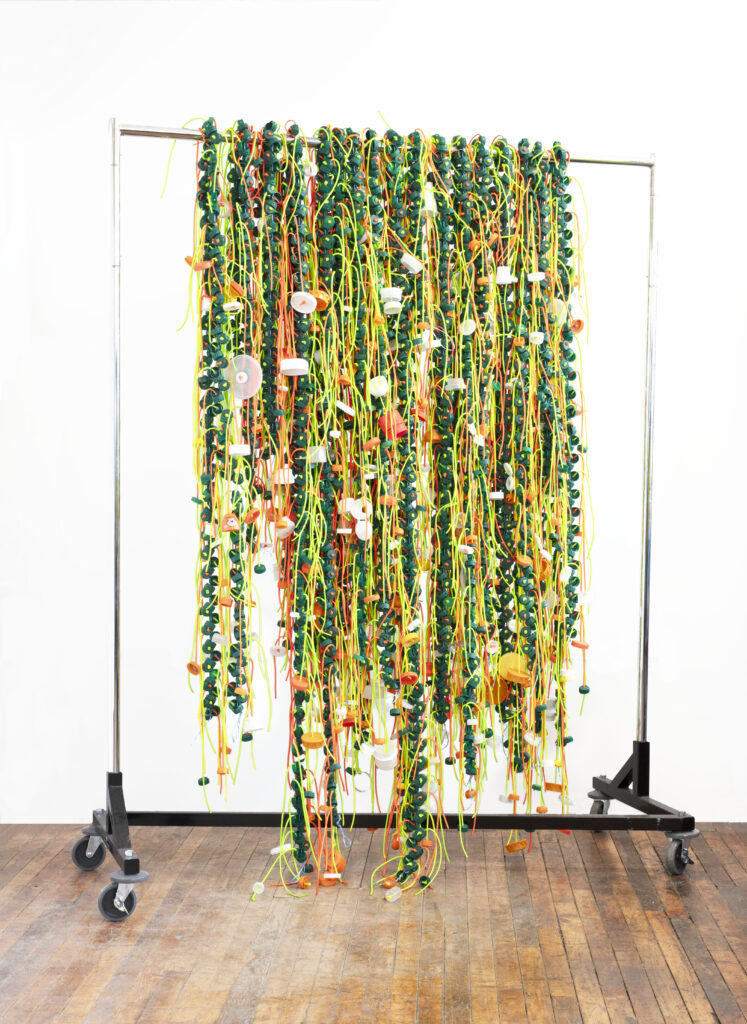
Polyurethane Paradise: Rainforest Rhapsody
Woven bottlecaps vines on blue and white polyurethane rope and paracord draped on rolling Z rack
79 x 12 x 72 in
2023