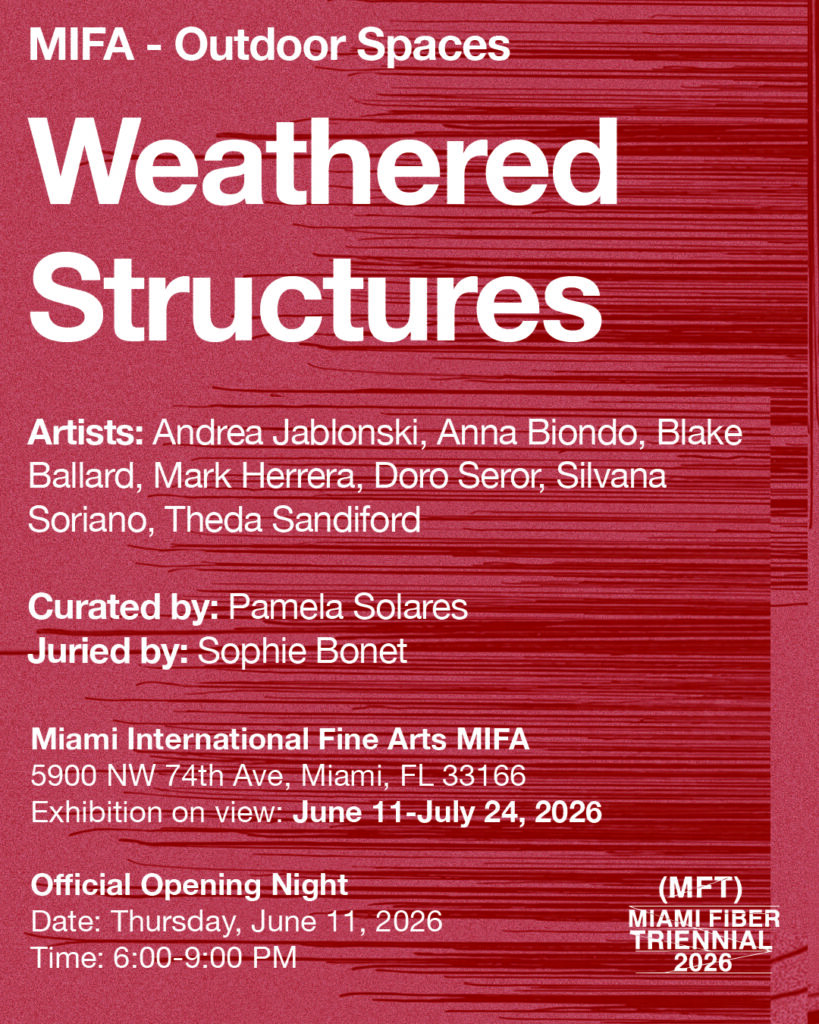
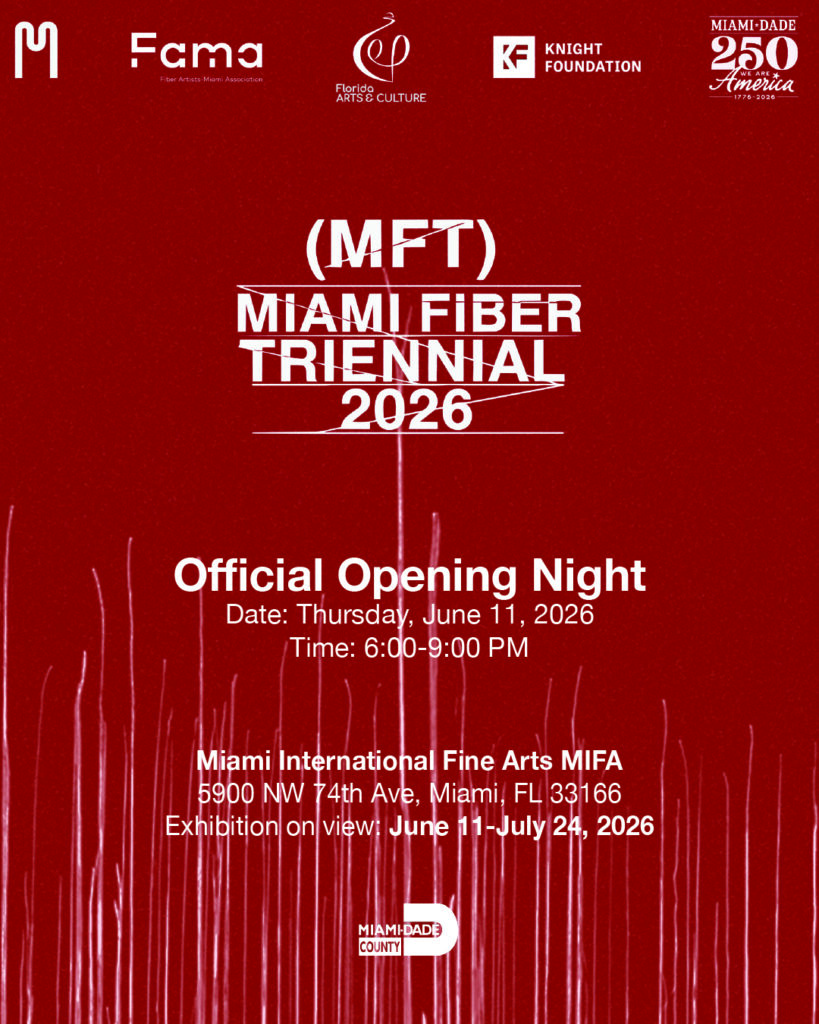
If you’re in Miami, there’s still time to catch Weathered Structures, part of the Miami Fiber Triennial, before the exhibition closes on July 23.
I’m honored to have my work included in Threading the City: America250, alongside an incredible group of fiber artists. The exhibition is sponsored by the Miami-Dade County Cultural Affairs Office and the Florida Arts & Culture National Endowment for the Arts Grant.
Exhibition Dates: June 11 – July 23, 2026 Location: 5900 NW 74th Ave, Miami, FL 33166
I won’t be able to make it to Miami before the show closes, so I’m asking for a small favor.
If you visit, I’d love to see the exhibition through your eyes. Take a few photos of my work (or your favorite pieces), tag me on social media or send them my way. Seeing where my work lands and how people experience it is one of the great joys of being an artist.
If you go, let me know what caught your attention. I always love hearing what you see.
There is something slightly ironic about creating an artwork for America250 while living in a United States territory where many residents cannot vote for the president determining so much of our daily reality.
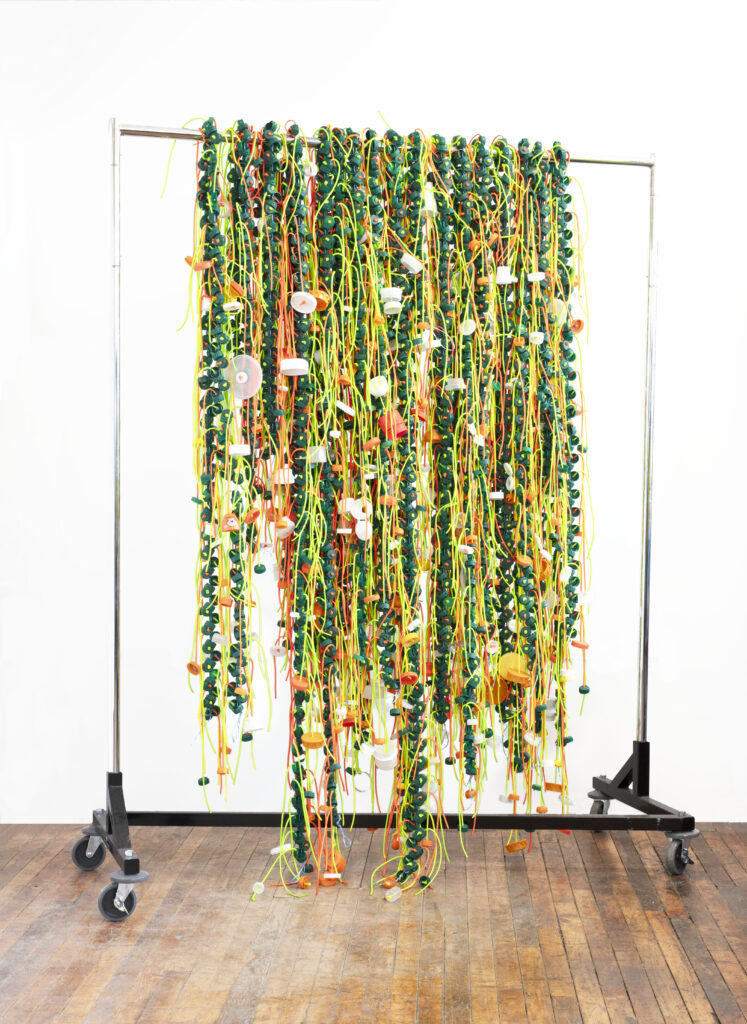
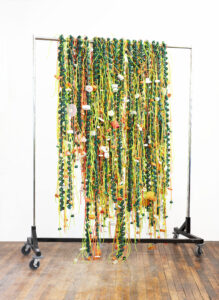
That tension sits quietly inside Polyurethane Paradise: Rainforest Rhapsody.
The work is included in Weathered Structures, part of the Miami Fiber Triennial 2026, a program connected to Threading the City: America250. While the broader celebration reflects on 250 years of America, I find myself considering what “America” means from the vantage point of St. Croix, US Virgin Islands, a place shaped by colonialism, tourism, environmental vulnerability, migration, and complicated citizenship.
From the outside, the Caribbean is often imagined as paradise.
And it is beautiful.
But paradise also arrives wrapped in plastic.
The work draws inspiration from the dense rainforest vegetation surrounding my home and studio in St. Croix. I wove together discarded single-use bottle caps into tangled vines, looping growths, and synthetic blooms inspired by heliconias, orchids, and Birds of Paradise. What first appears lush and celebratory slowly reveals itself as petroleum-based excess masquerading as tropical abundance.
Plastic has become one of the most persistent materials shaping island life. It washes ashore after storms, lodges itself into mangroves, drifts through guts and gutters, and survives longer than many of the systems meant to manage it. In island environments, consumption and disposal become impossible to separate from ecology.
The title Polyurethane Paradise intentionally leans into contradiction.
The work asks: What does paradise look like when filtered through tourism, waste, climate instability, and colonial economics? What does environmental celebration mean when the very materials used to sustain convenience are choking the landscapes they imitate?
As a place-based artist, I often forage shoreline debris, marine waste, seed pods, and discarded materials, allowing the environment itself to guide the work. In this installation, synthetic materials mimic organic growth patterns, blurring distinctions between the natural and manufactured world.
Installed outdoors, the work will continue changing in direct conversation with the elements, sun, rain, humidity, wind, and time. That vulnerability feels important. Especially in the Caribbean, where weather is never abstract.
Theda Sandiford Polyurethane Paradise: Rainforest Rhapsody Woven bottlecaps vines on blue and white polyurethane rope and paracord draped on rolling Z rack 79 x 12 x 72 in 2023
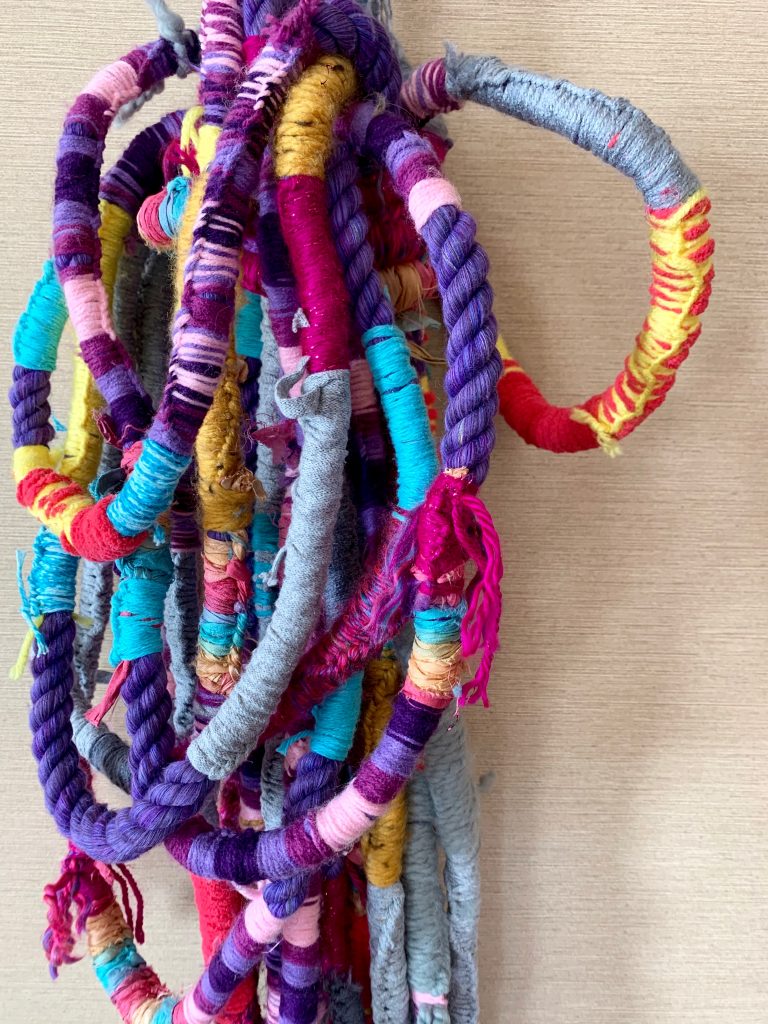
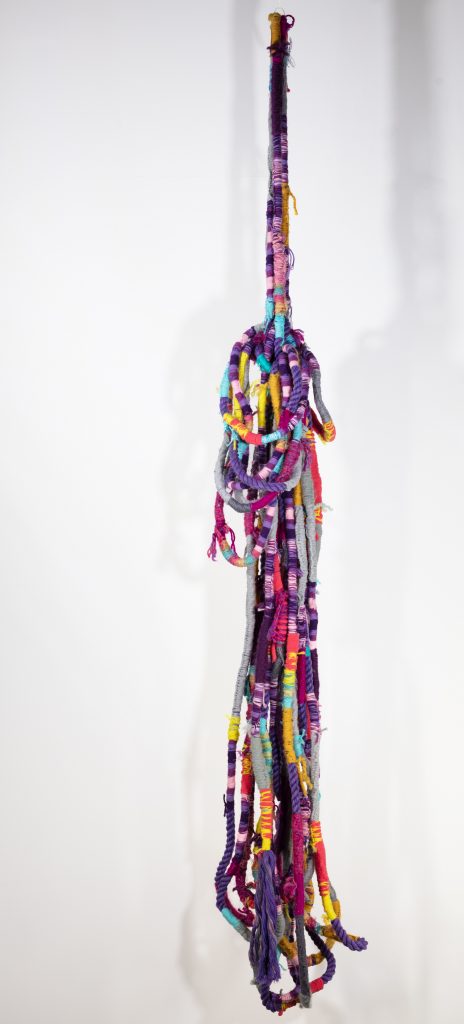
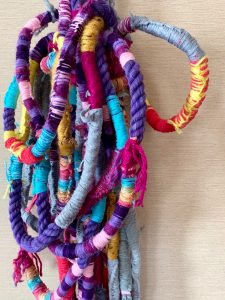
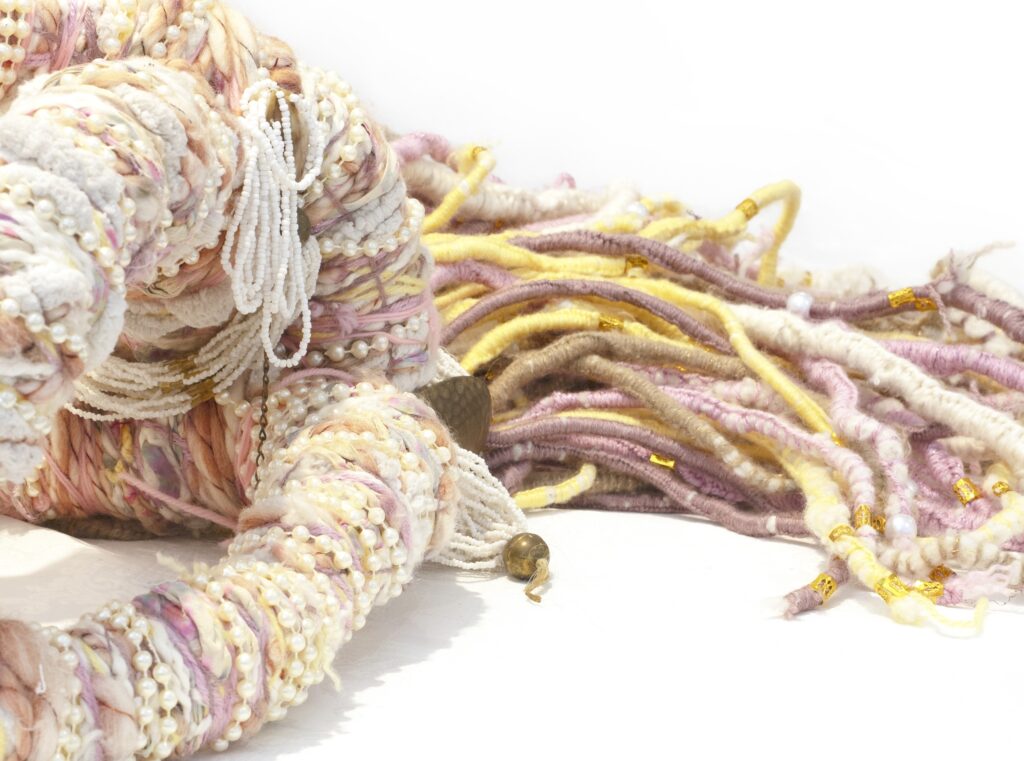
Caribbean Friendship Bracelet is one of the earliest works from my I Am My Hair series, a body of work that explores identity, memory, beauty standards, and the complicated relationship many Black women have with their hair. The piece is currently included in Fiber Forward at The Gallery at Yellow Studio in Cross River, New York, on view from May 30 through June 28, 2026.
The work began with rope.
I started wrapping and binding lengths of rope with yarn, recycled sari thread, ribbon, and fabric, slowly building forms that resembled braids, twists, locs, and tangled strands of memory. Brightly colored threads became extensions of personality and lived experience. What emerged was something playful on the surface, but rooted in deeper conversations around touch, identity, and belonging.
Hair carries history. It carries ritual, care, discipline, celebration, shame, pride, labor, and survival. For many Black women, hair is never “just hair.” It can shape how we move through the world and how the world responds to us.
Growing up, I learned early that hair could determine whether you were considered presentable, distracting, professional, acceptable, or beautiful. I remember the sting of hot combs, relaxers, tight braids, and being told my hair needed to be “managed” or “tamed.” I also remember the intimacy of sitting between someone’s knees while they braided my hair, the sound of beads clicking together, and the quiet rituals of care passed between generations.
This piece also reflects the experience of having personal boundaries crossed. The casual reaching out. The touching without permission. The fascination placed onto Black hair as though it were public property. Through this work, I wanted to create a space to reflect on those moments while also opening a bridge for conversation and understanding.
Part of the making process became communal. I invited people into my studio to wrap rope alongside me while we shared stories about our relationships with hair, beauty, family, and self-image. Their hands and conversations became embedded within the work itself.
The title Caribbean Friendship Bracelet speaks to connection, exchange, and collective memory. Like friendship bracelets passed from hand to hand, these wrapped strands hold traces of the people who touched them, contributed to them, and shared space during their making.
At its core, this work is about claiming space and honoring the fullness of who we are, in all our textures, complexities, and transformations.
Theda Sandiford
Polyurethane Paradise: Rainforest Rhapsody
Woven bottlecaps vines on blue and white polyurethane rope and paracord draped on rolling Z rack
79 x 12 x 72 in
2023
I’m honored to share that my work has been included in Weathered Structures, part of the inaugural Miami Fiber Triennial 2026 at Miami International Fine Arts (MIFA) in Miami, Florida. The exhibition opens on Thursday, June 11, 2026, with an Opening Reception from 6–9pm, and remains on view through July 24, 2026.
Weathered Structures brings together artists whose outdoor fiber works engage the body, the environment, public space, and the shifting conditions of weather and time. Through suspended forms, woven interventions, and repurposed materials, the exhibition considers how textile practices transform when exposed to the elements.
I’m especially grateful to be included alongside such thoughtful artists and within a city where I continue building connections, visibility, and community around my work. Miami has long felt like an important cultural crossroads for conversations around diaspora, materiality, climate, and layered histories, themes deeply connected to my practice.
My installation, Polyurethane Paradise: Rainforest Rhapsody, was inspired by the lush vegetation surrounding my rainforest home in St. Croix, USVI. Using woven single-use bottle caps, I created sprawling vines and floral forms that reflect the vibrant colors and tangled beauty of heliconias, orchids, and Birds of Paradise.
This moment feels especially meaningful. To participate in the first Miami Fiber Triennial and to have my work included in an outdoor exhibition centered around environmental response and transformation is both humbling and affirming.
Thank you to the Fiber Artists Miami Association (FAMA), MIFA, curator Pamela Solares, juror Sophie Bonet, and everyone helping bring this ambitious project to life.
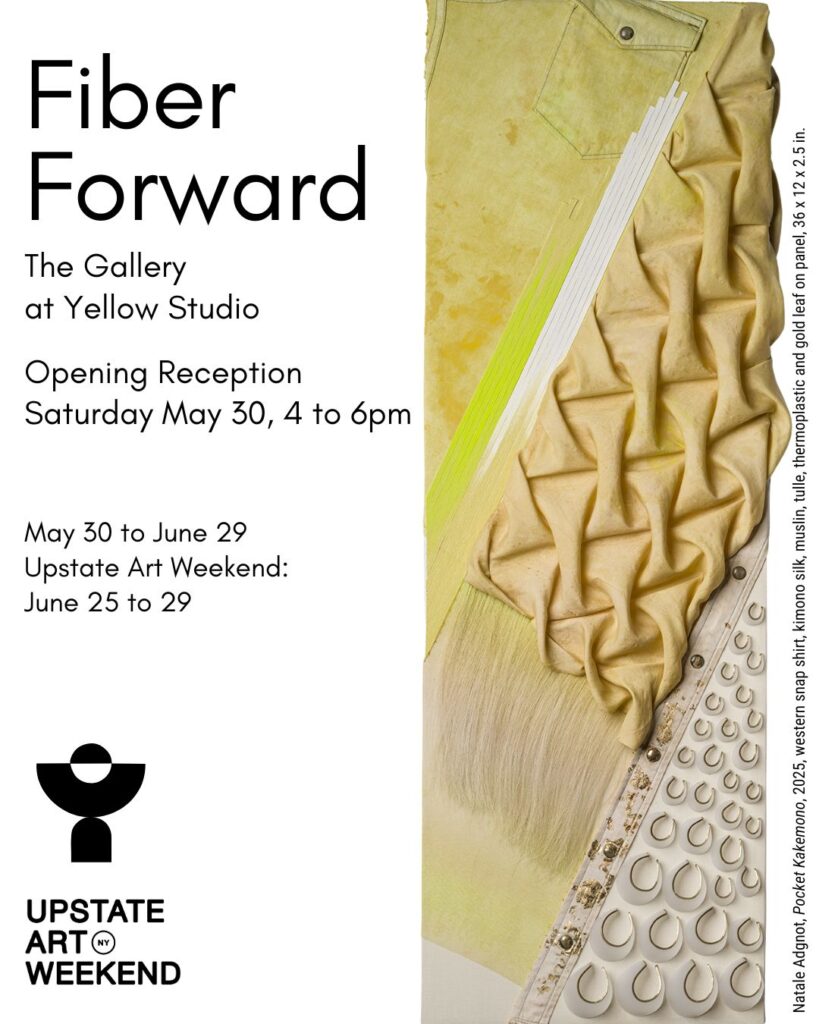
I’m deeply honored to share that my work Caribbean Friendship Bracelet has been included in Fiber Forward at The Gallery at Yellow Studio in Cross River, New York.
Fiber Forward brings together women and non-binary artists whose practices challenge and expand traditional ideas around fiber art. The exhibition explores how thread, rope, fabric, and other fibrous materials can hold memory, meaning, experimentation, and conversation.
The exhibition will be on view from May 30 through June 28, 2026, with an Opening Reception on Saturday, May 30 from 4–6pm. An Artist Talk will take place on Saturday, June 27 at 2pm during Upstate Art Weekend.
Included in the exhibition is Caribbean Friendship Bracelet, one of the earliest works from my I Am My Hair series. The piece is constructed from wrapped and embellished rope using recycled sari thread, ribbon, beads, zip ties, and other found materials. Through color, texture, and repetition, the work opens conversations around hair, identity, touch, and the lived experiences of microaggressions.
I’m grateful to be in dialogue with so many thoughtful artists working within fiber, materiality, and storytelling. Thank you to The Gallery at Yellow Studio for including my work in this beautiful exhibition.
June moves like a crossing. Two bodies of work, two distant geographies, each carrying its own truth about material, memory, and who gets to touch what.
Fiber Forward — Caribbean Friendship Bracelet
May 30 – June 28, 2026 The Gallery at Yellow Studio, Cross River, NY Artist Talk: June 27 (Upstate Art Weekend)
Caribbean Friendship Bracelet reads like hair before you read it as sculpture.
Extensions of rope; wrapped, woven, tied, and embellished with recycled beads, zip ties, ribbon, lace, tape, and bottle-cap bobbles, pull you in with color first. Hue as lure. Texture as invitation. Then the work turns.
These forms stand in for natural hair: bold, whimsical, and loaded. They open a door to conversations people often avoid, microaggressions, stereotypes, implicit bias, carried in something as intimate and public as hair.
Imagine, hair. The elusive, coveted “good” hair. On some days and for some people, that is my hair. Or was. Or can be. But you should know by now—Don’t. Touch. My. Hair.
This piece holds more than my hand. I invited the community into the studio, five people wrapping yarn, recycled sari thread, ribbon onto rope. We worked side by side, talking through the trials and negotiations of our hair. Their gestures live in the surface. Their stories are embedded in the tension of every wrap.
It’s not just a sculpture. It’s a collective record.
Miami Fiber Triennial: Exterior Interventions — Place as Material
June 11 – July 23, 2026 Threading the City: America250 Miami-Dade County Cultural Affairs / National Endowment for the Arts
In Miami, the work moves outward.
Fiber enters the city as a material system—bound to labor, migration, extraction, and care. It meets weather, infrastructure, and the public not as decoration, but as evidence.
As a place-based artist, I begin by walking—listening, foraging. Plants, seed pods, shoreline debris. Marine waste becomes material, but also record, carrying the imprint of tide, trade, and time.
Through weaving and knotting, I don’t transform these elements—I bring them into relation. Each piece is a conversation with the land and sea, shaped by what is revealed and what resists.
My practice moves across gardening, foraging, assemblage, weaving, moving image, sound, and installation because the story itself is layered.
Rooted in African diasporic knowledge and the weight of colonial and environmental memory, the work navigates inheritance and rupture—what has been preserved, buried, and what continues to surface.
Within the frame of America250, the work traces what has been built—and at what cost.
What does the land remember? What have we taken—and what remains? What continues to speak, whether acknowledged or not?
Across both exhibitions, the thread is clear:
Hair. Rope. Vine. Line. Each one a carrier.
Of touch. Of boundary. Of history that refuses to stay hidden.
If you meet the work this June, stand close, but understand what it asks of you.
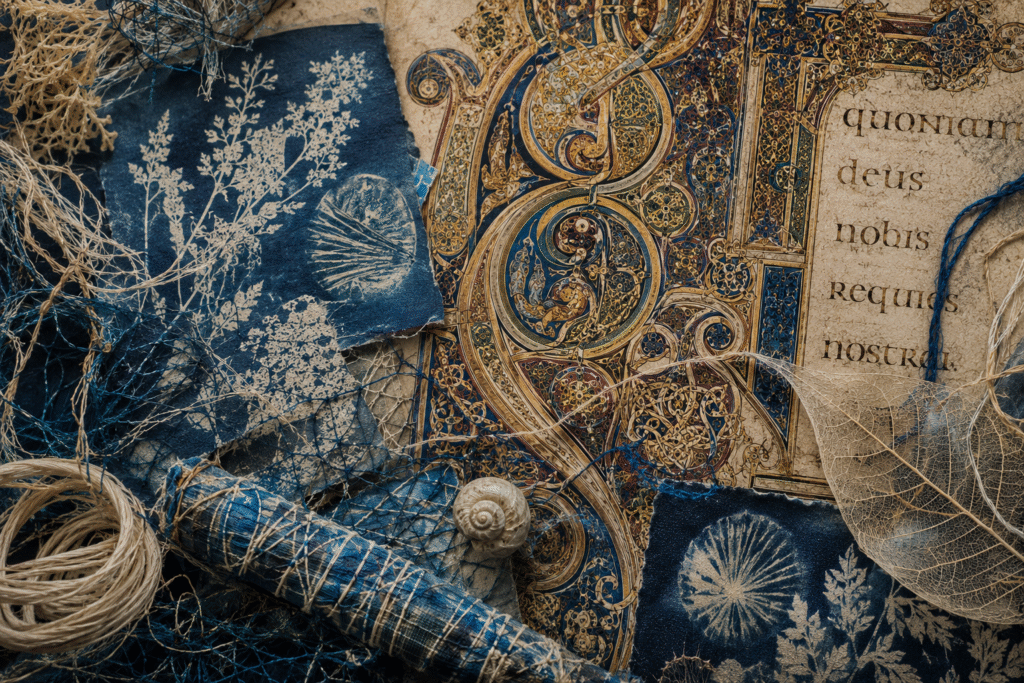
Reading about the new research surrounding the origins of the Book of Kells brought me back to the time I spent studying its pages last summer. Scholars are now reconsidering whether the manuscript may have originated in the Pictish monastery of Portmahomack in Scotland rather than solely within the Irish tradition it has long been associated with. What stayed with me most was the discussion around material process, vellum making, pigments, carving, ornament, and the close relationship between labor, devotion, and land.
While reading, I found myself thinking about how the Book of Kells moves beyond manuscript tradition and becomes something deeply tied to material knowledge and human touch. The layering of spirals, botanical forms, animals, symbols, and ornament carries a sense of accumulated care and attention over time. It also made me reflect on my own interest in wrapping, knotting, cyanotype, marine debris, and plant knowledge as ways materials can hold memory.
The manuscript is a reminder that making has long been connected to preservation, ritual, and the passing of knowledge across generations. Even centuries later, these works continue to speak through their materials as much as through their imagery.
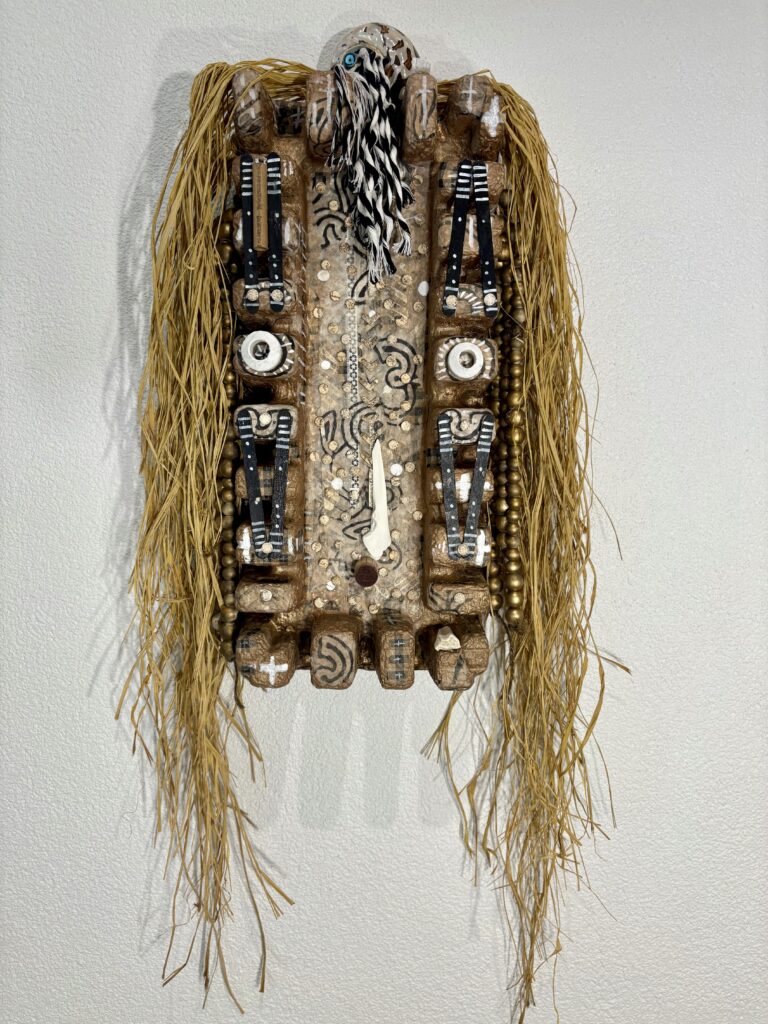
This mask began as fragments, discarded cardboard, envelopes once carrying bills, wine This one began with what was closest at hand, recycled cardboard, an envelope already opened, fragments of mono-printed deli paper. A wine cork, a piece of bone, shells still carrying salt. Nothing chosen for perfection, only for presence.
I built it through layering, raffia, yarn, string, wood beads, binding each material until it settled into place. Acrylic paint moved across the surface like a seal, then a reveal. Small elements, pop sticks, wood chips, a shard of selenite became both structure and quiet signal.
The process was intuitive, almost call-and-response. Add, layer, remove, pause. Listen. Adjust.
This first mask holds the origin of the series: a gathering of discarded things finding voice together. Not polished, not resolved but awake. A vessel of protection, memory, and becoming.
The studio has been loud lately, not in sound, but in pull.
I’m working across multiple series at once, moving from one piece to another, then back again. Rope on one table. Foraged material drying in the corner. A vessel half-bound. A line of thought that won’t sit still. It feels a little ADHD in the studio, attention splitting, doubling back, chasing sparks before they cool.
It’s a gift and a curse.
Focus, for me, doesn’t look like a straight line. It looks like orbit. One piece unlocks another. Finishing something doesn’t close it, it opens a door. I’ll tie off one work and immediately see where it wants to go next. So I follow it, even if it means holding five things at once.
Right now, I’m in that stretch, finishing, resolving, pushing pieces to their edge while new ideas keep interrupting. I don’t fight it. I work like an octopus, reaching, holding, testing, building across everything all at once.
All of it is moving toward my solo show at Cane Roots Gallery in Christiansted, opening later this year. The work is rooted here, in St. Croix. New rhythms. New materials. New material histories. What the land offers. What the sea leaves behind. What the island reveals over time.
There are not enough hours in the day to bring every idea into the light. I’ve had to accept that. Some things will wait. Some will evolve. Some will never be made and that’s part of the practice too.
But what is here, what is becoming, is enough.
Each piece carries the imprint of this moment of working in motion, of holding many threads, of trusting that even in the scatter, there is a pattern forming.